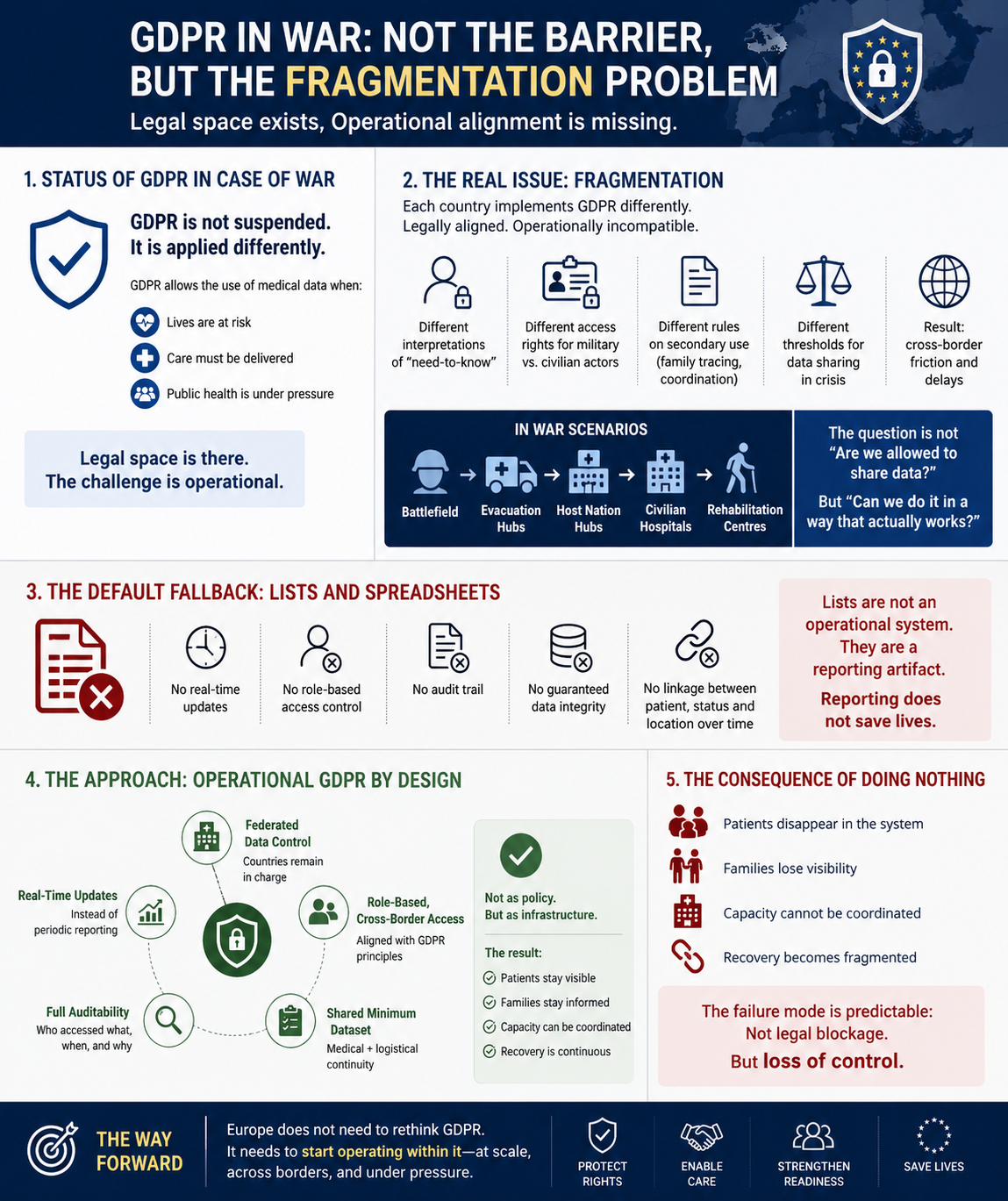
GDPR Does Not “Switch Off” During War
GDPR is not suspended during war.
It is not deactivated during crises.
And it is not designed to prevent life-saving medical coordination.
The regulation already provides legal grounds for processing and sharing medical information when:
lives are at risk,
urgent care must be delivered,
public health systems operate under extreme pressure,
or critical humanitarian interests are involved.
The legal space already exists.
The real challenge lies elsewhere.
The Operational Problem Is Fragmentation
While GDPR is a European regulation, its operational implementation differs significantly between countries and organisations.
In practice, this creates fragmentation around:
interpretations of “need-to-know,”
access rights for military versus civilian actors,
secondary use of medical data,
crisis-level escalation procedures,
and thresholds for cross-border information sharing.
The result is a paradox:
Legally aligned.
Operationally incompatible.
And that incompatibility becomes highly visible once casualties start moving internationally.
The Complexity of Cross-Border Casualty Movement
In a large-scale conflict scenario, wounded military personnel may move through:
NATO medical evacuation structures,
Rearward and Host Nation Hubs,
civilian hospitals,
specialised trauma centres,
rehabilitation facilities,
and long-term recovery networks.
Across multiple countries.
Across different healthcare systems.
Across organisations operating under different interpretations of the same regulation.
At every stage, medical updates, transfer status, patient location and care continuity must remain operationally available.
The question is therefore no longer:
“Are we legally allowed to exchange medical data?”
But rather:
“Can we make it operationally work across borders, under pressure, and at scale?”
The Spreadsheet Reality
When no operational infrastructure exists, organisations fall back on what is available:
lists,
spreadsheets,
static extracts,
email chains,
manually updated reports.
These approaches may work for administrative reporting.
They do not work for operational patient flow management during large-scale medical crises.
The limitations are well known:
no role-based access control,
no guaranteed data integrity,
no continuous synchronization,
no reliable audit trail,
no real-time situational awareness,
and no structured continuity between patient identity, medical status and location.
Most importantly:
they do not scale.
Lists and spreadsheets are not operational coordination systems.
They are reporting artifacts.
Reporting does not save lives.
What Europe Actually Needs
Europe does not necessarily need new GDPR legislation for wartime medical coordination.
What is needed is operational implementation.
That means systems designed from the beginning around:
federated data ownership,
country-level control,
role-based access management,
cross-border interoperability,
shared minimum datasets,
real-time synchronization,
and full auditability.
Not as a policy discussion.
But as operational infrastructure.
From Legal Debate to Operational Readiness
As Europe increases its focus on resilience and military preparedness, medical coordination can no longer remain dependent on fragmented processes and disconnected information flows.
The wounded will move across borders whether systems are ready or not.
The real challenge is therefore not whether GDPR allows cooperation.
The challenge is whether Europe can operationalise that cooperation before a crisis forces it to.